How Much Does It Cost to Set Up a Nonwoven Production Line?
There's no fixed price for a nonwoven line. See which stages drive the cost, plus installation, energy, factory and small-to-high capacity scenarios to build a budget.

Ask five suppliers how much a nonwoven production line costs and you may get five very different figures. That is not because anyone is being evasive. There is no fixed price for "a nonwoven line," because a line is not a single machine — it is a coordinated sequence of process stages sized to one product, one width, and one output target. The honest framing for any buyer is not "what does one cost?" but "what structure makes up the cost, so I know which decisions move the number?"
This guide walks through that structure: how each stage of a carded needle-punched or thermal-bonded line drives capital cost, where the money goes beyond the machinery line itself, and how the picture changes across small, medium, and high-capacity setups. It deliberately leaves out equipment dollar quotes — the total is too configuration-dependent for a generic figure to be useful — and instead gives you the cost levers to reason about your own project.
The two layers of nonwoven production line cost
Every nonwoven project splits into two distinct layers that are easy to blur together:
CAPEX — the upfront capital: the production line itself, the factory to house it, and the installation that gets it running.
OPEX — the lifetime operating cost: raw material, energy, labor, maintenance, and waste — the recurring money that, for most plants, ends up far larger than the upfront figure.
The ratio matters. Across the industry, raw material and energy dominate regular operating cost, with fiber or polymer typically representing the largest single recurring item and energy a significant share. What this means in practice is that an "expensive" machine can be the cheap buy if it cuts energy per ton or scrap — and a cheap line can be costly if it cannot hold quality. Understanding cost structure beats chasing a headline price on either side.
Before diving into stages, it helps to anchor what "complete" means. A complete nonwoven production line runs through material preparation, web formation, bonding, and finishing — the four-part scope laid out in Sail's complete nonwoven production line buyer's guide. From fiber opening through to a wound, saleable roll, that frame is where every cost driver below belongs. Getting that boundary clear up front is the single most useful step in comparing quotes.
Breaking down the cost by line stage
Each stage of the line carries its own equipment cost, and the two levers that push every one of them up are working width and target throughput. Automate a stage or widen the machine, and its cost rises; keep it narrow and semi-automatic, and it stays leaner. The stages below follow the fiber from bale to roll.
Raw material preparation
Before fiber reaches the web, it has to be stored, dosed, and conditioned around the line's appetite. The cost here is not a big single machine but a collection of auxiliary units — storage and conveying, dust control at load points, and whatever finish treatment the recipe needs. The real driver is match to throughput: preparation must reliably feed the carding stage without starving or jamming it.
Opening & blending
This is where compressed fiber bales are broken apart and tufts opened, then proportioned and blended into a consistent mix — often mixing base fiber with low-melt binder or recycled content. The equipment spans bale openers, pre- and fine openers, blenders, metering and feeding units, and the dust-extraction that keeps the area safe. Higher capacity, finer recipes, and accurate multi-component blending all raise the cost here, because the machinery has to process more fiber per hour without introducing weight variation.
Carding
Carding is usually the largest single capital step in the web-formation chain, because it does the delicate work of separating and aligning millions of fibers into a uniform web. Working width is the dominant lever: a wider card needs a bigger cylinder, larger doffers, a heavier frame, more drives, and substantially more web-control hardware. The practical rule is that carding cost climbs steeply with width and with the consistency demanded at high output.
Cross lapping
The cross lapper folds the carded web back and forth to build up the thickness and loft needed for heavier, higher-GSM products. Its cost is driven by width, the lay-expansion ratio it must span, carriage speed, and the reversal system that keeps layer edges uniform. Lines that lay many layers at high GSM — such as cross-lapped geotextiles or felts — need a more capable, more expensive cross lapper than a light, single-pass web.
Needle punching or thermal bonding
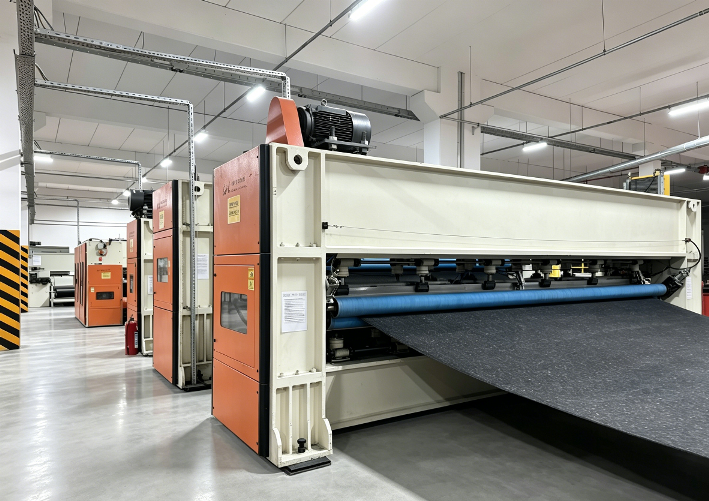
The bonding section is typically the most expensive part of the line after web formation, and which technology you choose sets a different cost profile. Needle punching consolidates the web by driving barbed needles through it to entangle the fibers; here the cost rises with loom width, the number of looms or needle zones in sequence, punching density, and stroke rate — which is why heavy felt lines often run several needle looms within a needle punching production line. Thermal bonding fuses low-melt or bicomponent fibers through heat; that cost centers on the heating system and its width, temperature-control precision, throughput, and cooling section, which is exactly the territory of a thermal bonding production line. A thermal (oven/calender) line is generally more energy-intensive than needle punching, which has no polymer melt — but thermal bonding buys much higher line speed on lighter products.
Winding & cutting
The finishing end turns the bonded web into saleable rolls. Cost here follows roll width, winding speed, tension control, edge trimming, and how many finished widths you slit on the line. Heavily automated roll handling and in-line cutting add capability and cost, but they remove a lot of manual labor from a repetitive task — a trade worth weighing as a line grows, not an afterthought.
Automation: a cross-cutting cost and saving
Automation is not a single module; it threads through the whole line. PLC-based controls, sensors, drives, human-machine interfaces, and data/monitoring systems raise the upfront figure, sometimes meaningfully. In return, they cut operators per line, improve consistency and reduce scrap, and give you the diagnostics that keep a line running. The right amount of automation depends on your labor market and how much process variation your products tolerate — fully automatic is right for some plants, and simpler is genuinely better for others. On a well-specified builder like Sail Nonwoven Machinery, automation is scoped in with the line: Siemens motors and inverters integrated into the drive train, with PLC/HMI controls and CE certification treated as part of the project rather than add-ons priced in later.
Beyond the machine line: installation, energy, and factory
The equipment sequence is only part of the budget. Three more buckets quietly decide whether a project comes together on time and within its cost envelope.
Installation and commissioning
Machines do not run on arrival. They must be lifted in, aligned, wired, and integrated into a working line, then commissioned with trial runs and operator training. As an estimating heuristic, professional installation and commissioning commonly land around 10–15% of the machine cost — a meaningful line item that is easy to under-budget. Small modular lines may install and commission in weeks; large integrated lines run on for months as bonding quality, airflow, and throughput are tuned together. Forgetting this stage is how a project "overruns" even when the equipment was priced fairly.
Energy consumption
Energy is where structure shows up most clearly in the running budget. As a recurring share it is substantial — and it scales with what the line actually does. A needle-punch line draws power for carding, web transport, and the hundreds of strokes per minute of the needle looms, but no melting heat. A thermal-bonding line adds significant heat for its oven or calender, so its energy per ton can be higher even at similar mechanical power. There is one useful counterintuitive point: larger lines usually deliver a better kWh per ton than small ones, because fixed auxiliary loads spread across far more output — which is part of why the energy economics improve with scale.
Factory requirements
The building is an entire cost dimension. A mid-size line with its auxiliaries and fiber storage commonly needs on the order of 1,000–3,000 square meters, while a compact modular line may fit in a few hundred. Clear height typically ranges from about 5–7 meters for simple setups to 8–12 meters for full card/crosslap/bonding lines with ducting and maintenance access. Structural floors must carry the heavy point loads under needle looms, wind-up stands, and ovens. Utilities are a project in themselves: installed electrical power can span roughly 300 kW to over 1 megawatt as lines grow, compressed air demand rises with pneumatic devices, and fiber fly from opening, carding, and needling makes robust dust extraction and ventilation mandatory. Because nonwoven plants are fiber-rich combustible occupancies, fire protection — sprinklers, spark detection in ducting, and careful storage — is standard engineering, and thermal zones deserve extra care.
This is why a responsible supplier won't quote you a line without knowing your site. The utilities, footprint, floor loading and site readiness that a line needs are part of the scoped project, not an assumption you should make yourself.
Comparing small, medium, and high-capacity setups
Cost structure changes character as the line grows. Rather than a single price, it is more useful to see how the parameters shift across three common scales — because dollar figures are configuration-specific, but the shape of the project is not.
Small / pilot | Medium | High-capacity | |
|---|---|---|---|
Typical working width | ~1.5–2.4 m | ~2.4–3.2 m | ~3.2–4.5 m and wider |
--- | --- | --- | --- |
Character | Modular, semi-automatic | Fully automatic, partly integrated | Wide, high-speed, fully automated + monitoring |
Automation | Basic controls | PLC + modern drives | Full automation, integrated data/handling |
Building footprint | Few hundred m² | ~1,000–2,000 m² class | 1,000–3,000+ m² with auxiliaries |
Installed power | ~100–300 kW | ~300–800 kW | ~800 kW–1.5+ MW |
Install & ramp | Weeks; faster to stabilize | 4–10+ weeks | Months; long integrated tuning |
Energy per ton | Higher (fixed loads on small output) | Moderate | Better kWh/ton at high utilization |
Cost posture | Lowest upfront; good for niche/pilot | Balanced, flexible via slitting | Highest upfront; best unit economics if fully loaded |
The pattern behind the table is consistent: width and automation are what buy throughput, and they are also what buy cost. A small pilot line is attractive when you are proving a product or serving a niche and want a modest, flexible entry. A medium line is the flexible workhorse — wide enough to slit into several saleable product widths, with output to justify real volume. A high-capacity line makes sense when contracts demand wide, continuous sheet and you can keep it utilized, because only then does the better energy per ton and lower unit cost actually pay off.
Turn cost structure into a smarter budget
The takeaway is that you should stop asking "how much does a nonwoven line cost?" and start asking "what is the cost structure for the width, GSM, product, and output I actually need?" A few checks keep any comparison honest:
Scope it completely — confirm every stage from fiber preparation to wound roll is included, and what is "by others" (utilities, civil works, in-plant handling).
Catalog the non-equipment buckets — installation, energy, and the factory/utility build-out are real line items, not overhead to discover later.
Size for your product and utilization — a wide, fully automated line only earns its cost when continuously loaded; match scale to realistic demand, not ambition.
Verify before you commit — ask for the site and utility schedule the line needs, and agree a factory acceptance test with clear pass criteria.
Set up that way, the exercise stops being about getting a magic number and becomes what it should be: a scope-driven way to compare lines on total cost of ownership — the metric that determines whether a line earns its keep for the years you will run it.
If you want help turning a target product into a scope-based cost framework, the engineers at Sail Nonwoven Machinery can walk through your working width, GSM range, and output target to lay out the line stages and a realistic cost structure before you go to RFQ — the cheapest way to de-risk a machine you will run for years.