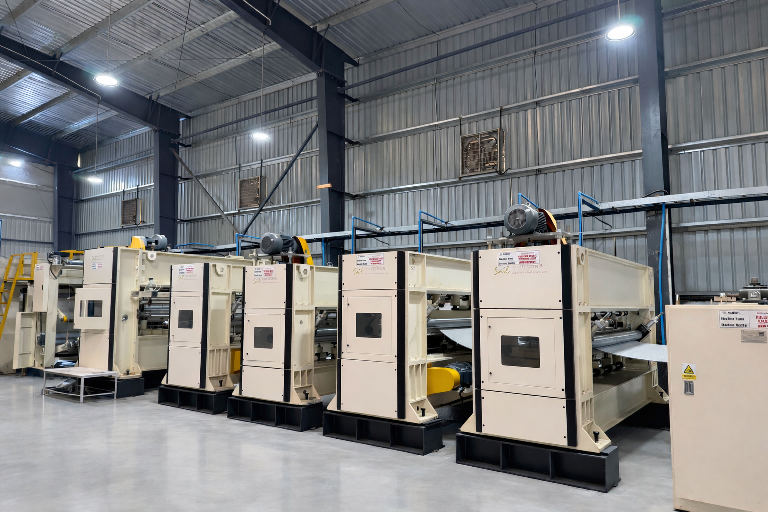
What Determines the Capacity and Performance of a Nonwoven Production Line?
Understand nonwoven production line capacity through width × GSM × line speed × fiber type × process, and separate theoretical output from real capacity when comparing lines.

When a supplier tells you a line can produce "X tons per day," the number only means something if you know the conditions behind it. The same piece of equipment can legitimately be quoted at very different capacities depending on the product you run, the fiber you feed, and how fast you can hold a stable process. That confusion is normal — and it is why capacity gets discussed with so much imprecision in this industry.
The good news is that nonwoven production line capacity follows a logic you can put on a whiteboard. It comes down to five variables working together: working width, GSM, line speed, fiber type, and process. Once you understand how they combine, you can translate any supplier claim into a number you can actually plan against.
The capacity chain: width × GSM × speed sets the ceiling
Think of a carded nonwoven line as laying down a fixed amount of fiber per square meter and moving that sheet forward. The theoretical mass throughput depends on three things at once:
Output (kg/h) ≈ Working width (m) × Line speed (m/min) × Fabric weight (g/m²) × 60 ÷ 1000
That simple relationship, spelled out in a technical manufacturer explainer on nonwoven production capacity, is where every capacity conversation should start. A wider line produces more fabric per minute. A faster line produces more meters per hour. A heavier GSM puts more mass into every square meter. Fiber type and the bonding process then decide how fast the line can run reliably at that specification — which is why they belong in the same sentence as width, GSM, and speed.
Why the same line gives different real capacity
The formula above is a ceiling, not a promise. It assumes an uninterrupted line running at its set speed with no waste. In a real plant, the saleable output is lower once you account for startup scrap, trimming, roll changes, changeovers, cleaning, process adjustments, and rejected material. This is why the same production line can credibly be quoted at different capacities by different people — and why experienced buyers separate three numbers:
Maximum machine speed — the mechanical upper limit of the equipment.
Recommended (stable) operating speed — what the line holds day to day for a given product without drifting out of tolerance.
Saleable output — the qualified fabric actually produced during normal operation, which is the number that matters for your business case.
Actual output also depends on whether fiber preparation, web formation, bonding, and process control can stay stable at the running rate. So when you compare capacity claims, ask for all three numbers, not just the headline tonnage.
How GSM affects line speed
GSM — grams per square meter, often called basis weight — is how much fiber sits in every square meter of fabric. Higher GSM means more material must be laid down and consolidated per unit of area. If the area of fabric per minute stays fixed, a heavier product consumes more fiber feed, more forming time, and more bonding dwell.
In practice, that usually forces the line to slow down. A thicker, denser web needs more residence time to form uniformly and to bond fully, and the fiber-opening and feeding equipment can only deliver so much mass per minute. So, as a rule of thumb:
Low GSM (e.g., lightweight hygiene or wadding layers) → less fiber per meter → the line can run faster.
High GSM (e.g., heavy geotextiles or felts) → more fiber per meter → the line runs slower to keep weight uniform and bonds complete.
This is why a typical gauge for a heavy-geotextile needle punching line is around 1–6 m/min, while lighter thermal-bonded webs can move far faster. Wider or heavier products rarely multiply throughput the way a naive "faster = more" reading of the formula would suggest, because speed and GSM trade against each other once the equipment reaches its feed or bonding limits.
How to choose a working width: 2.5 m, 3.2 m, or 4.5 m
Working width is the single biggest lever on total output — at a fixed speed and GSM, doubling width roughly doubles how much fabric you make per hour. But width is not free. Capital cost, building footprint, and the difficulty of holding uniform web quality all rise as the machine grows. The choice is really about matching width to your product formats and volume rather than grabbing the widest available line.
Working width | Strengths | Tradeoffs | Typical fit |
|---|---|---|---|
2.5 m | Lower capital cost, smaller footprint, easier startup and uniformity control, flexible for mixed or specialty runs | Lower total output, fewer slit-width options, less headroom for growth | Specialty felts, moderate or pilot-scale production, diversified small-volume products |
3.2 m | Best balance of output and flexibility; supports slitting into multiple saleable widths and several SKUs | Higher machine and building cost than 2.5 m; more demanding web control | Mainstream industrial production and growth-oriented plants |
4.5 m (and wider) | Highest throughput per line; produces wide, seamless sheets for large end products | Much higher capital cost, larger handling/downstream slitting needs, harder width-uniformity control | Large geotextiles and wide-format industrial webs where utilization stays high |
A wider needle-punching line puts more demand on fiber distribution and even needle penetration across the sheet; a wider thermal line raises the bar for heater, airflow, and nip consistency. So the deciding questions are: how wide are your final products, how much tonnage do you actually need, and can you keep a wide line continuously utilized? If volume is uncertain, a 3.2 m line is often the safer long-term buy because it can be reconfigured through slitting into many product widths. If your contracts already need wide-format sheet, a 4.5 m-class line is the practical route.
This is a good moment to see the range in practice. For a nonwoven carpet needle punching line, working width can go up to about 4500 mm at a listed capacity of roughly 100–300 kg/h; for heavy geotextile needle punching line configurations, width can reach much wider with capacity scaling to several hundred kg/h. Those figures underline why "depends on width and GSM" is the honest answer to most capacity questions.
Why fiber type affects capacity
Fiber type does not appear in the width × GSM × speed formula, yet it quietly decides how fast a carded line can actually run. Carding works by mechanically separating and aligning fibers, and each polymer and fiber geometry behaves differently under that treatment.
The properties that matter are linear density (denier or dtex), staple length, crimp, finish, and rigidity. Finer fibers increase friction and contact, which can improve cohesion but also raises carding resistance and the chance of damage. Stiffer or more brittle fibers — including many natural and recycled technical fibers — are harder to open and card evenly, so they typically force a slower, gentler process. Even between the two workhorse synthetics, there is a difference: polyester tends to card in a more stable, forgiving way, while polypropylene can sometimes be carded fast but is more prone to static and wire loading that pulls down the sustainable rate.
For practical planning, this gives a useful rule: longer staple fibers at a moderate denier with a proper finish maximize stable throughput, and expect finer or harder-to-process fibers to lower the speed you can hold before defects appear. When a supplier quotes line capacity, always ask which fiber, denier, and staple length that number assumes — because the answer changes when you switch polymer.
Why needle punching and thermal bonding run at different speeds
Process is the variable that most directly explains why two "production lines" can have wildly different throughput. Bonding is what sets the practical speed ceiling, because each technique has a different dwell-time limit.
Needle punching consolidates the web by driving barbed needles through it, again and again, to physically entangle the fibers. The web has to stay in the needling zone long enough to receive the target number of punches per area, and mechanical penetration simply takes time. The result is a slow but very controllable process well suited to thick, tough, heavy webs — which is why heavy geotextiles and felts typically run at only about 1–6 m/min on many lines.
Thermal bonding, by contrast, fuses low-melt or bi-component fibers by passing the web through heat, sometimes under light pressure, in a continuous pass. Because the "bonding time" per meter is short, the line can move much faster — commonly in the range of roughly 100 m/min and, on suitable lightweight products, well beyond that. Freudenberg Performance Materials describes exactly this divide in its technical overview of web bonding: needled fabrics are limited by long dwell because the needles stay in the web, while thermally bonded fabrics can reach much higher line speeds depending on weight.
The two are not interchangeable — needle punching buys mechanical strength and bulk for a slow line, while thermal bonding buys throughput on lighter, lofty, or mattress-type products. That is why the "capacity" of a needle punching line for geotextiles and a thermal bonding line for wadding are so different even at the same width and GSM. It is not that one is better; it is that they are built to consolidate the web in different ways with different speed ceilings.
Turning capacity math into a production line procurement decision
Once you hold the five variables together, the right way to compare a line becomes clear. Start with your product — its GSM band, width, fiber recipe, and the target properties it must hold — then work out the throughput each process can realistically sustain. A few checks keep the comparison honest:
Ask for capacity at your GSM and width — not the supplier's best-case number on an easy grade.
Confirm whether the quoted rate is maximum machine speed or a stable, saleable operating rate.
Check how speed and GSM trade off on the specific line (heavy-grade output is usually lower than light-grade).
Confirm which fiber, denier, and staple length the capacity assumes.
Match working width to your final product formats and realistic utilization, not the widest available option.
Validate the "depends on width and GSM" answer by seeing the line on your target geometry, whether at FAT or in a documented reference installation.
⚠️ Warning: A capacity quote without its GSM, width, fiber, and process assumptions is not a capacity quote. Buying a line sized to the wrong product family — or to a theoretical speed you can't hold on your heaviest grade — is usually far costlier than sizing it correctly at the outset.
Sizing a nonwoven production line capacity for the products you actually run
Nonwoven production line capacity is not a single number; it is the product of working width, GSM, line speed, fiber type, and process — reduced by the reality of stable operation. Understand those levers, and you can read any supplier claim, catch the numbers that are being left out, and size a line that earns its keep on the products you actually make.
If you are at the stage of turning a target product into a capacity envelope, the engineering team at Sail Nonwoven Machinery can help you walk through your GSM range, working width, and fiber recipe to define a realistic capacity target before you commit to an RFQ. Starting with the right capacity math is the cheapest way to de-risk a machine you will run for years.