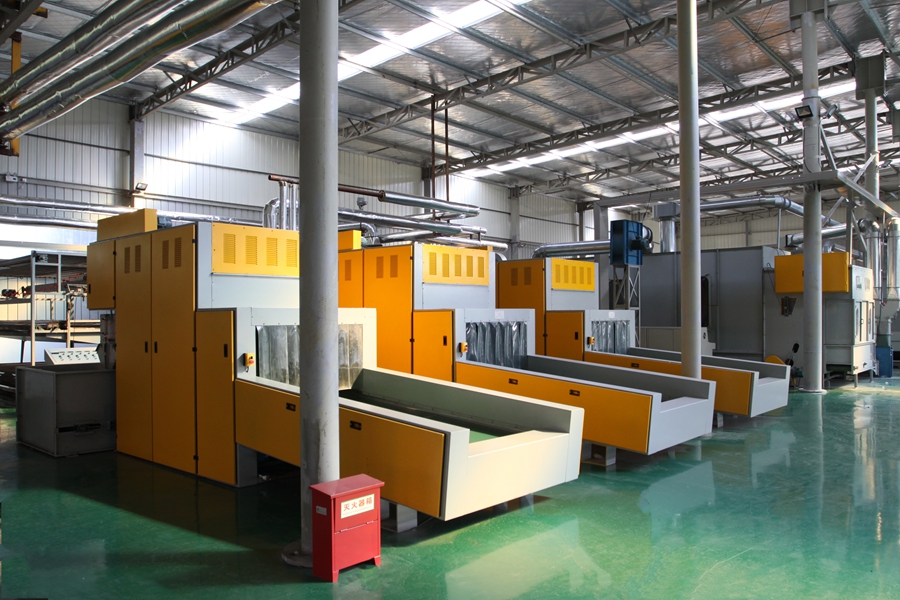
Thermal Bonding Padding Production Line for Hard Mattress Padding: What to Specify, What to Verify
Spec-led buyer guide: width up to 4000mm, 100–5000gsm, 100–600kg/h, heating options, and what to verify before requesting a quote.

If you’re sourcing a thermal bonding padding production line for hard mattress padding, the fastest way to avoid expensive surprises is to treat the project like an engineering spec—then validate it like a production run.
This guide is written for plant managers, operations leaders, and procurement teams who need a line that can consistently hit width, GSM, and output targets—without trading away controllability, serviceability, or compliance.
Start with the process fit (so your specs make sense)
Thermal-bonded nonwovens are produced by forming a fiber web (commonly via carding and/or air-lay), building up weight and thickness (often with cross-lapping), and then consolidating the web using heat so thermoplastic components bond the structure. Industry associations like EDANA describe thermal bonding—especially through-air bonding—as a way to create bulkier products by bonding webs containing low-melt fibers in controlled hot air (see EDANA’s “Nonwovens manufacturing process”).
For hard mattress padding, the practical takeaway is simple:
GSM capability isn’t just a number—it depends on stable feeding, web formation, and the bonding window.
Output depends on how width, GSM, heating method, and product structure interact.
Line speed only matters if bonding quality and uniformity hold at that speed.
Pro Tip: When you compare quotes, ask suppliers to state the stable operating window (width × GSM × output) and what test method they use to demonstrate it.
Thermal bonding padding production line evaluation criteria for hard mattress padding
A spec sheet that looks good on paper can still fail in production if your evaluation criteria aren’t aligned to how hard padding is made and inspected.
1) Working width and width flexibility
Hard mattress padding often needs wide-format stability—especially if you’re producing in rolls and slitting downstream.
What to verify:
Maximum working width you need today—and whether you’ll need headroom later.
Uniformity across the full width (not just “nominal width”).
Edge trim and waste assumptions.
2) GSM range (and how stable the GSM is across the width)
GSM is a direct lever for product feel, thickness targets, and cost per square meter. For padding applications, buyers should treat GSM as both a range and a repeatability requirement.
What to verify:
Minimum and maximum GSM the line can run in your fiber blend.
Changeover behavior (how quickly the line stabilizes after recipe changes).
Uniformity measurement method (what is measured, where, and how often).
3) Output capacity (kg/h) under real product conditions
Capacity is where optimistic assumptions hide. Output should be assessed as a function of:
width,
GSM,
heating method,
and the bonding recipe.
What to verify:
Output at your target padding spec (not only at an easy “demo” spec).
Scrap/yield expectations over a continuous run.
4) Line speed and controllability
Line speed is valuable only if it’s controllable and repeatable. If you don’t have a published speed number, your procurement team can still evaluate speed the right way:
What to verify:
Speed stability during a multi-hour trial.
Synchronization between feeding, web formation, and bonding.
Whether speed changes require re-tuning temperature/airflow (and how that’s managed).
Parameter advantages that matter (and how to turn them into procurement leverage)
If you want a line that covers multiple product grades and future-proofs capacity expansion, your strongest leverage in vendor selection is the parameter window—the range you can operate in without sacrificing stability.
Sail Nonwoven Machinery’s configuration range is designed for wide-format, high-GSM hard padding projects:
Production width: up to ≤4000 mm, made to order
GSM capability: 100–5000 gsm (supports both lighter and very heavy padding structures)
Production capacity: 100–600 kg/h (configuration-dependent)
These ranges matter because they reduce the chance you’ll outgrow the line when you add new SKUs (wider widths, heavier GSM, or higher output targets).
To see the line scope and discuss configurations, start with the official page for Sail Nonwoven Machinery’s Thermal-bonding Padding Production Line.
⚠️ Warning: Don’t accept “max” figures without defining test conditions. Always ask: width, GSM, fiber blend, heating method, and run duration.
Fiber and heating options: where operating cost and product feel get decided
Hard mattress padding is sensitive to fiber selection and bonding energy. If you’re aiming for predictable quality and controllable cost, your quote should clearly define both raw material compatibility and heating configuration.
Raw material compatibility (for application flexibility)
Sail Nonwoven Machinery’s line can be configured to process common padding fibers such as PP fiber, PET fiber, and shoddy fiber (and similar blends), which is useful if you run multiple recipes or incorporate recycled inputs.
Heating resources (match to your plant and your TCO model)
Heating is one of the biggest operating-cost drivers in thermal bonding. Sail’s line supports multiple heating resources, including:
Gas burner
Thermal oil (boiler)
Electrical heater
The best choice depends on your local energy prices, safety requirements, and how you prefer to manage temperature stability.
Serviceability signals: components, quality system, and compliance
When the line is part of your core capacity, procurement should treat serviceability as a first-class spec.
Sail Nonwoven Machinery builds with an ecosystem of commonly specified industrial components (examples include Siemens, Siemens Beide, NSK, CHINT, and others), which supports maintenance familiarity and parts sourcing.
On the manufacturing side, Sail emphasizes:
TQM across the manufacturing process
Trial testing before delivery
Certifications including ISO 9001 and CE
For many buyers, the combination of trial testing + documentation + CE/ISO signals reduces integration risk—especially for export-oriented production and audited factories.
For broader thermal bonding padding applications, you may also want to review Sail’s related thermal-bonding wadding production line and browse the full Sail Nonwoven Machinery products portfolio.
RFQ checklist: what to include when you request a quote
If you want quotes that are comparable (and usable), include these in your RFQ:
Target end product: hard mattress padding (describe structure and roll/sheet requirements)
Required working width (mm) and finished/slit widths
GSM range you plan to run now (and likely future grades)
Target output (kg/h) at the key product spec(s)
Fiber recipes to be supported (PP/PET/shoddy and blend ratios)
Heating preference (gas / thermal oil / electric) and your local utility constraints
Quality requirements: GSM tolerance, thickness/loft targets, inspection method
Acceptance testing plan: what you want proven in trial testing/FAT-style runs (run time, sampling method, pass/fail criteria)
Documentation requirements: drawings, manuals, spare parts list, electrical standard
Installation/commissioning expectations and operator training plan
Next step: request a configuration-based quote (not a generic price)
If you share your required width, GSM range, target output, fiber recipe, and heating preference, Sail Nonwoven Machinery can quote a configuration that matches your operating window—and align the trial testing plan to the same spec.
Request a quote with configuration options via the Sail Nonwoven Machinery Thermal-bonding Padding Production Line page, and include your RFQ checklist items so you get an engineering-grade proposal.