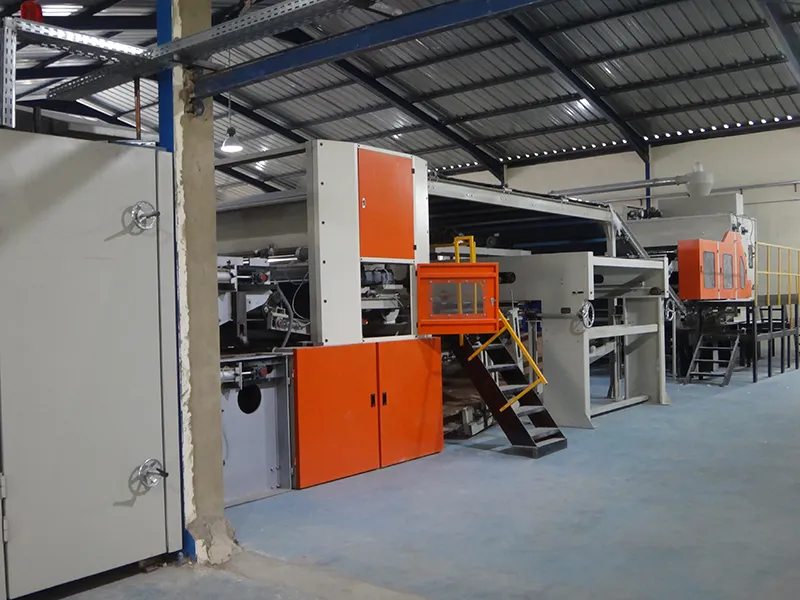
Thermal Bonded Padding Production Line Buyer Guide
RFQ-ready checklist to evaluate through-air thermal bonding lines: web forming, specs, oven uniformity, utilities, safety, FAT/SAT.

Buying a thermal bonded padding production line isn’t like buying a standalone machine. You’re buying a system that has to deliver three things at the same time: consistent bonding, repeatable loft/hand feel, and predictable operating cost. The fastest way to reduce risk is to specify the right performance envelope up front—then verify it in acceptance testing.
This guide is written for procurement and sourcing teams who need an RFQ-ready evaluation framework for a thermal bonded padding production line based on through-air thermal bonding.
1) What this line is used to produce
A thermal bonded padding line is designed to produce nonwoven padding materials used as:
Home textile filling (quilt padding, comfort layers)
Furniture padding (sofa and cushion filling)
Mattress and bedding components (padding layers, comfort fills)
Apparel insulation layers
Automotive interior padding and comfort layers
Thermal and acoustic insulation materials
The common requirement across these applications is a web that is soft, bulky, and resilient—not just “strong.”
2) The core technology: through-air thermal bonding
Through-air bonding (also called through-air thermal bonding) uses hot air to bond a fiber web with minimal compression. In simple terms, heated air passes through the web, a thermoplastic binder component softens/melts at fiber contact points, and the structure is fixed as it cools.
Two reasons it matters for padding:
Loft is preserved. Because the web isn’t heavily compacted during bonding, you can keep a thicker, airier structure.
Hand feel stays soft. Bonding happens at many small contact points rather than by saturating the web with chemicals.
For a plain-language overview of the mechanism and why it’s used, see WPT Nonwovens’ explanation of through-air bonding (2021) and ANDRITZ’s air-through bonding overview.
Key Takeaway: In padding applications, the “right” bonding is usually the one that meets strength and dimensional requirements without collapsing loft.
3) Raw materials: what actually bonds the web
Thermal bonded padding lines are typically designed for blends such as:
PET polyester fiber
PP fiber
Low melting fiber (low-melt)
Bi-component (bicomponent) fiber
In RFQs, it helps to spell out what you mean by “low-melt.” Many plants will specify low melting fiber (sometimes written as low-melt fiber) as the binder component—so it’s worth confirming melt point range, blend ratio flexibility, and how bonding quality will be validated at your target loft.
A common approach is to blend “regular” structural fiber with a binder fiber:
Mix conventional fibers with a percentage of low-melt or bicomponent fibers
Heat in the through-air oven
The low-melt sheath (or low-melt component) softens/melts and bonds the web
Cool to lock the structure in place
Compared with adhesive/chemical bonding, this method avoids chemical glue and is often positioned as a cleaner process route. A broader technical discussion of nonwoven bonding methods (including thermal bonding) is summarized in a 2020 review in The Journal of Engineered Fibers and Fabrics.
4) Standard process flow and the modules you should map in an RFQ
A typical thermal bonded padding line is built around this flow:
Opening & blending
Bale opening / opening and mixing
Fine opening and feeding
Web forming
Carding (fiber web formation)
Web laying (cross lapper or vertical lapper)
Bonding & finishing
Through-air thermal bonding oven
Cooling and setting
Optional calendaring/ironing (for surface finish and thickness control)
Winding and/or cutting
In RFQ terms, this is useful because it forces alignment between what you want to produce (loft, thickness, resilience) and which modules are truly required (for example, whether a vertical lapper is necessary).
5) Cross lapper vs vertical lapper: how web formation changes the product
Many buyer conversations focus on the oven, but web formation often determines whether the product feels like “padding” or just “layered wadding.”
Cross lapper (cross-laying)
Cross lapping lays the card web back and forth to build thickness in layers. It’s commonly chosen when you need:
stable basis-weight uniformity over wide widths
consistent layered structure
a broad range of general padding and wadding products
Cross lapping is also a precision step that can influence overall speed and uniformity. For a technical note on cross-lapper layering and line implications, see Trützschler’s crosslapper line guidance.
Vertical lapper (vertical lapping)
Vertical lapping folds the web in a vertical orientation, which typically increases:
achievable loft/thickness
upright resilience and rebound
“springy” padding feel
This is often the better fit when the end product is a thick, resilient padding structure (for example, mattress and furniture components).
Pro Tip: If your product spec emphasizes rebound and “body” more than flatness, discuss a vertical-lapper web structure early—otherwise you risk over-engineering the oven to compensate for the wrong batt architecture.
6) The technical envelope to specify for a thermal bonded padding production line
When you write an RFQ, include ranges and the conditions under which they must be met. Based on the provided line description, typical ranges for this class of line are:
Working width: 2000–4000 mm
Finished product width: up to ~3600 mm
Basis weight (GSM): 60–3000 gsm
Capacity: 100–600 kg/h
Line speed: up to ≤100 m/min on some configurations (treat as a maximum, not a guarantee)
Heating options: electric heating / gas heating / thermal oil
Procurement note: ask suppliers to quote capacity at your target GSM and thickness—not just the maximum speed.
7) What to evaluate (beyond the spec sheet)
A padded nonwoven buyer guide is mostly about reducing hidden risk. These are the checks that typically separate a line that “runs” from a line that runs predictably.
A. Bonding quality and uniformity (the oven is the system bottleneck)
Ask how the line controls:
airflow distribution through the web
temperature zoning and stability
residence time consistency
edge-to-center uniformity across full working width
What to verify in acceptance testing:
stable loft/thickness across width and along the roll
no over-bonded stiff zones and no under-bonded weak zones
repeatable quality after warm-up and after grade changes
B. Product changeover capability
Padding producers rarely run one product forever. Ask about:
time to change GSM targets
fiber blend changeover and cleaning requirements
recipe control in PLC/HMI (repeatability matters)
C. Utilities, energy, and heating choice
Thermal bonding lines are commonly offered with electric, gas, or thermal-oil heating. Selecting the heating option is a procurement decision, not an afterthought.
In your RFQ, include:
available fuels/utilities on your site
required temperature range and control needs
expectations for energy monitoring and operating cost reporting
D. Maintenance access and uptime expectations
Ask for a preventive maintenance plan that covers:
fan and duct inspection/cleaning
filter access and replacement intervals
belt tracking and wear points
sensor calibration
A supplier that can’t explain the maintenance “rhythm” clearly is a risk—especially for hot-air systems.
E. Safety, compliance, and documentation
Even for US-focused projects, you’ll often see CE or CE-aligned documentation requested because it signals a structured approach to machine safety and documentation.
At minimum, ask for:
risk assessment approach and safety interlocks
guarding, emergency stops, and safe access design
manuals, wiring diagrams, spare parts lists, and recommended critical spares
For the official EU context on machinery compliance and CE marking, see the European Commission’s machinery guidance.
8) RFQ checklist you can reuse
Use this as an RFQ appendix so engineering and procurement stay aligned.
A) Product targets
Target applications (bedding/furniture/apparel/automotive/insulation)
Target basis weight range (GSM)
Target thickness/loft and rebound expectations
Required finished width and edge-trim allowance
B) Line capability
Working width
Capacity target (kg/h) at your GSM
Speed target (m/min) at your GSM
Fiber types and blend ratios supported (PET/PP/low-melt/bicomponent)
C) Process configuration
Web formation choice: cross lapper or vertical lapper (and why)
Through-air oven zoning and airflow design
Cooling and setting configuration
Optional calendaring requirements
D) Quality & testing
Proposed FAT scope: what will be proven before shipment
Proposed SAT scope: what will be proven after installation
Sample roll acceptance criteria (uniformity, loft, bonding consistency)
E) Support & lifecycle
Installation/commissioning scope
Operator and maintenance training
Warranty terms
Recommended spare parts list and lead times
9) Red flags (and how to avoid them)
Specs without conditions. “600 kg/h” is meaningless unless tied to a GSM/thickness and quality target.
Oven-first thinking. If the batt architecture is wrong, you’ll chase quality with heat and airflow.
No acceptance plan. If FAT/SAT is vague, you inherit the performance risk.
Documentation gaps. Missing manuals/spares lists delay commissioning and increase downtime risk.
Next steps
If you’re building an RFQ, the fastest path is to write down four numbers—target width, GSM range, capacity at target GSM, and your preferred heating option—then validate the web formation approach (cross lapper vs vertical lapper) against your end product.
Sail Nonwoven Machinery can support configuration discussions for through-air thermal bonding padding lines based on your target envelope and plant constraints. Start with their products overview and request a configuration + quotation discussion with your width/GSM/capacity targets.
FAQ
Is thermal bonded padding the same as thermal bonded wadding?
The core bonding mechanism is similar, but “padding” usually emphasizes thicker structures, rebound, and support, while “wadding” often emphasizes softer filling layers for bedding and apparel. In RFQs, the difference shows up most clearly in web formation and target thickness/recovery.
What fiber blend is most common for through-air thermal bonding?
A typical approach is mixing a structural fiber (often PET or PP) with a binder component such as low-melt or bicomponent fiber. The binder component softens/melts during heating and creates bonds as the web cools.
Should I choose a cross lapper or a vertical lapper?
Choose based on the product’s target structure. Cross lapping is a reliable general-purpose layering approach. Vertical lapping is often chosen for higher loft and better upright resilience—commonly needed in thick padding products.
Do I need calendaring after the oven?
Not always. Calendaring can be used as an optional finishing step to adjust surface feel and thickness tolerance. It should be specified only if your downstream product spec requires it.