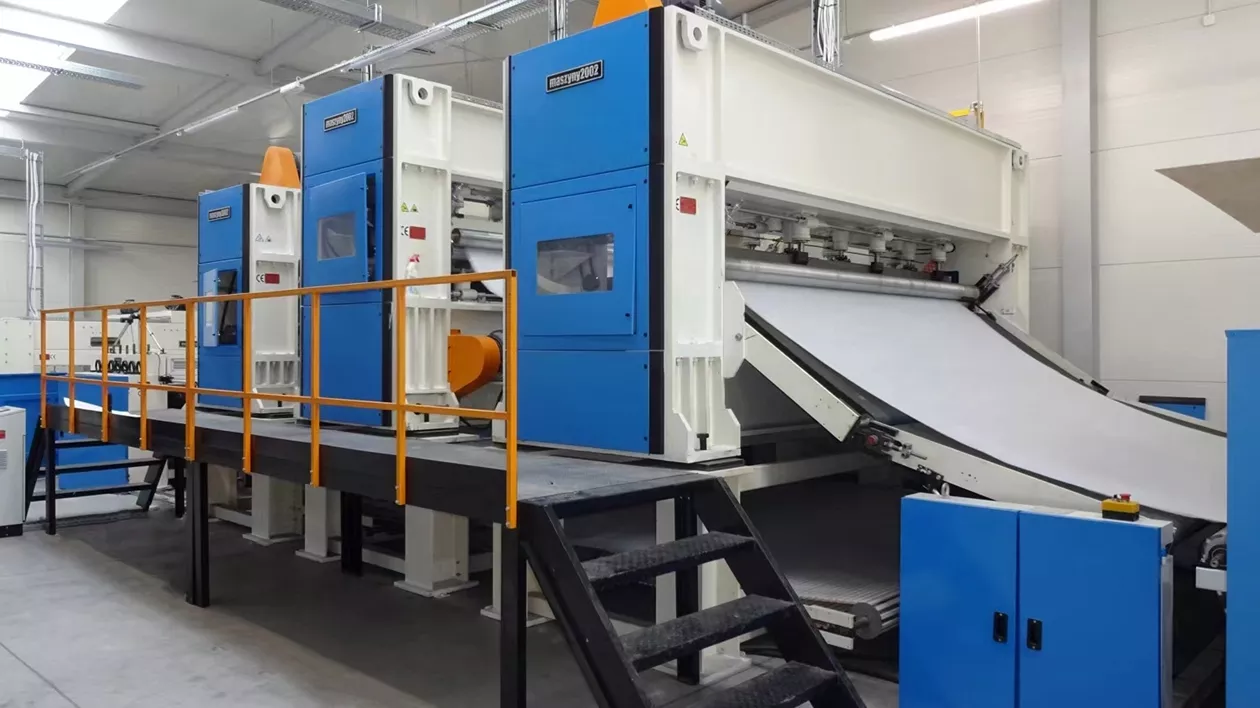
Shoe Material Needle Punching Production Line: RFQ-Ready Guide for Insole Felt and Substrate Materials
Decision-stage guide to line modules, configuration questions, and FAT checkpoints for insole felt and shoe-material nonwovens.

If you’re preparing an RFQ for shoe-material nonwovens—such as insole board substrate felt or other reinforcement layers—the fastest way to de-risk your purchase is to get crisp on two things early: what the production line includes, and how you’ll verify output quality during FAT.
This guide walks through a typical Shoe Material Needle Punching Production Line configuration, the decisions that matter before you request a quotation, and practical acceptance checkpoints—without guessing at specs that should be confirmed in your technical annex.
What a Shoe Material Needle Punching Production Line is (and what it’s for)
A needle punching production line mechanically reinforces a fiber web by repeatedly driving barbed needles through it, entangling fibers into a coherent nonwoven structure. Industry associations like EDANA describe needlepunching as a core nonwoven bonding method for producing durable engineered fabrics (see EDANA’s overview of how nonwovens are made).
For shoe material applications, the line is typically configured to produce stable, uniform, cuttable felts used as substrates (for example, insole board layers) and other nonwoven shoe material components.
Typical process flow: modules and what each one controls
A typical configuration includes the following modules (exact scope depends on your end product and factory constraints):
Bale openers → stabilize fiber feeding and enable blend ratios
Fiber openers / blending → break clumps and improve mix consistency
Hopper feeder → controls feed uniformity into carding
Carding machine → forms a uniform, oriented web
Cross lapper → builds batt thickness and balances MD/CD structure
Needle punching machines (needle looms) → entangle fibers to target density and strength
Calendering / ironing (as required) → surface finishing and density/thickness tuning
Winding machine → stable roll formation for downstream cutting/lamination
Why this matters for shoe materials
Footwear-related felts are unforgiving to variability: small swings in basis weight (GSM), thickness, or surface uniformity can show up later as cutting issues, poor lamination, inconsistent lasting performance, or reject spikes.
A practical mental model is:
Upstream opening/blending protects you from batch-to-batch variability.
Carding + cross-lapping largely determines uniformity and structure.
Needle looms determine entanglement, strength, and the feel of the material.
Finishing (calendering/ironing) helps you lock in the final surface and thickness profile.
Raw materials and end products: align early
Shoe-material needle-punched felts are commonly produced from PET fiber and other fibers, depending on your end-product requirements and local fiber supply. Before you lock the line configuration, document:
target end products (e.g., insole board substrate felt; shoe material reinforcement felt)
target basis-weight and thickness ranges (as acceptance bands)
whether you need single-layer vs. multi-layer structures
any special requirements: recycled content, odor/VOC considerations, color, surface smoothness, lamination compatibility
Key Takeaway: A clean RFQ starts with measurable output bands (ranges and tolerances), not marketing descriptions.
Configuration decisions to settle before you request a quotation
Decision-stage buyers usually lose time (and credibility) when the RFQ is vague. These are the configuration questions worth resolving up front.
1) Product spec bands and verification method
Instead of asking for “high quality,” define what “pass” means:
Basis weight (GSM) uniformity: how you’ll sample and calculate variation across the width/length
Thickness uniformity: measurement locations and frequency
Tensile / tear: test method and direction (MD/CD)
Surface defects: what counts as a defect, and how it’s graded
For insole-related materials, SATRA publishes a set of test methods for insoles that can help teams align on what to measure (see SATRA’s list of test methods for insoles). You don’t need to adopt every method—but referencing an established test library prevents misunderstandings between operations, QA, and procurement.
2) Line layout, utilities, and integration constraints
Ask for a layout proposal that reflects your real site:
available floor space and access paths
material infeed and finished-roll handling
power, compressed air, and dust control expectations
upstream/downstream integration (e.g., impregnation, coating, lamination, slitting)
3) Needle loom strategy (where quality is won or lost)
Needle punching is the bonding step. Practical questions to clarify with your supplier:
number of needle looms (pre-needling + main needling) needed for your density/hand-feel targets
single-sided vs. double-sided needling needs
needle maintenance approach: change intervals, spare needles, and troubleshooting workflow
Avoid accepting broad statements like “high speed” unless you can tie them to your acceptance plan (trial run duration, defect thresholds, and stable operation window).
4) Finishing: when calendering/ironing is worth it
Finishing equipment (such as calendering/ironing units) is typically chosen to improve:
surface smoothness and visual uniformity
thickness stability
roll build quality for downstream processing
The right choice depends on whether your shoe material is used as a standalone felt or a substrate that must bond consistently to other layers.
FAT-ready acceptance: what to verify before shipment
A Factory Acceptance Test (FAT) is your last chance to validate the line at the supplier’s facility before it becomes a site-installation problem. If your organization doesn’t already have a FAT protocol, a general guide like the S3 Process overview of Factory Acceptance Testing (FAT) can help you structure responsibilities, pass/fail criteria, and punch-list handling.
Here’s a practical FAT checklist tailored to needle punching production lines.
FAT checklist (practical)
A) Documentation and design scope
General arrangement drawing and final line layout
Electrical schematics and a complete I/O list
Safety devices list, risk assessment summary, and operating manuals
Consumables/spares list (including needles) and recommended stocking levels
B) Mechanical and electrical checks
Guards, interlocks, and emergency stops function as designed
Drive systems run smoothly across the agreed operating band
Web path is stable: no chronic skewing, edge damage, or abnormal vibration
C) Trial run with agreed raw material
Use the same (or equivalent) fiber type/blend you’ll use in production
Confirm stable operation for a continuous run (duration agreed in the FAT plan)
Record operating settings used for the accepted sample
D) Output verification (sample plan)
GSM and thickness sampling across width and along the roll
Tensile/tear per agreed method and directions
Visual inspection criteria: holes, stripes, thin spots, edge defects
Roll build: hardness uniformity, telescoping tendency, edge quality
⚠️ Warning: Don’t sign off FAT without a written “accepted settings + accepted sample” package. Otherwise, the line is accepted but the process isn’t.
Commissioning, training, and after-sales: what to lock down contractually
Decision-stage risk usually isn’t “can the line run?” It’s “can we keep it running at spec in month three?” Make sure the commercial package answers:
commissioning scope (remote vs on-site), timeline, and responsibilities
operator and maintenance training: who, how long, what materials
spare parts lead times and escalation paths
warranty terms and what’s excluded (consumables, misuse, etc.)
For many global buyers, compliance and documentation readiness is part of vendor qualification. Sail Nonwoven Machinery positions its lines around strict QC and CE-oriented delivery practices at the brand level, alongside installation/commissioning and training support.
A simple RFQ worksheet (copy/paste)
Use this checklist to write a cleaner, faster-moving RFQ:
End product(s): ______________________________
Target GSM range and tolerance approach: ______________________________
Target thickness range and tolerance approach: ______________________________
Raw material(s): PET / other: ______________________________
Finishing needs: calendering/ironing / slitting / winding requirements: ______________________________
FAT trial material + trial duration: ______________________________
Output test list (GSM/thickness/tensile/defects/roll build): ______________________________
Documentation required: drawings / electrical / manuals / spares list: ______________________________
Installation constraints (space, utilities, handling): ______________________________
Next steps
If you want an RFQ package that’s easy to evaluate and hard to misunderstand, start with the official product scope and then request a configuration-specific spec sheet.
Review the product scope on the official Shoe Material Needle Punching Production Line
Request a spec sheet + FAT plan template via Contact Sail Nonwoven Machinery