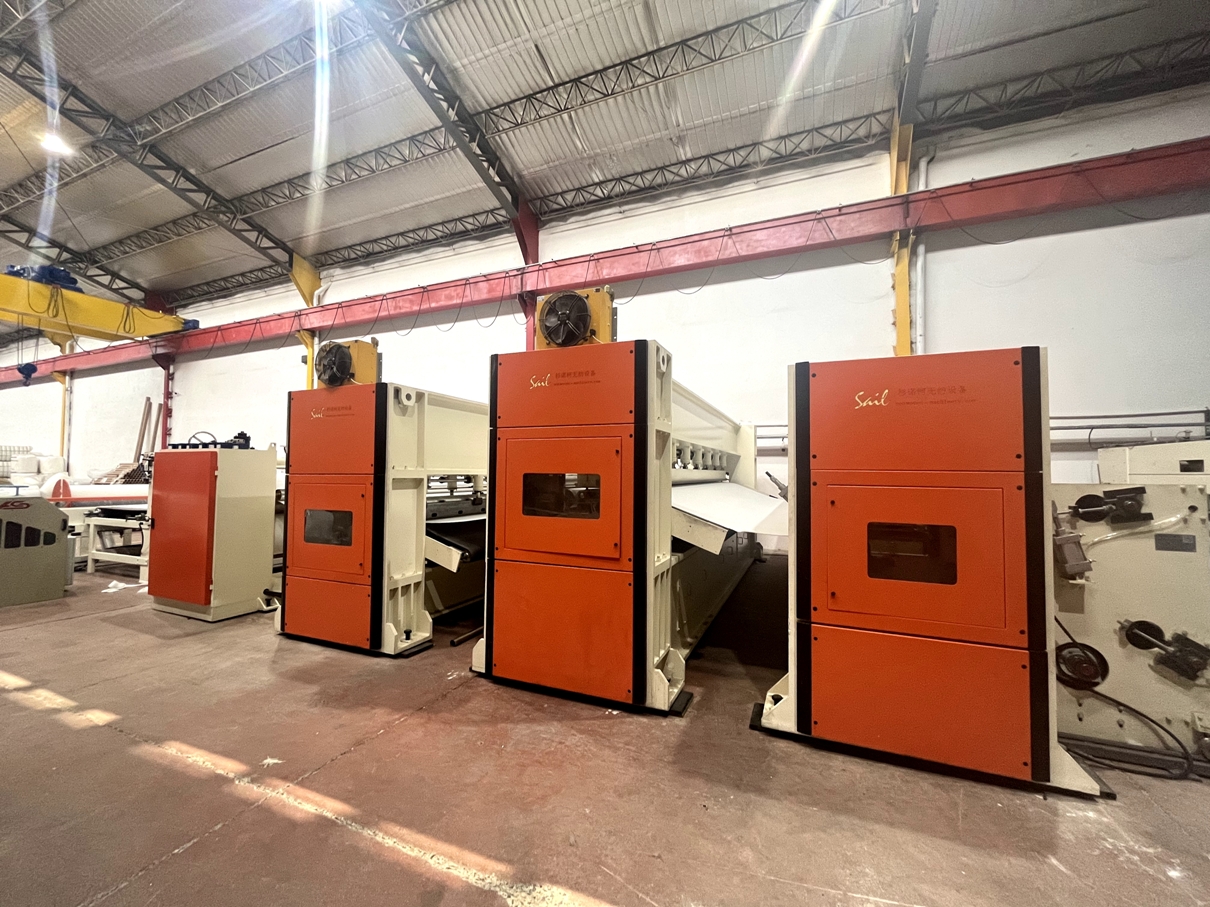
Needle Punching Machine (Needle Loom): How Needlepunch Builds Nonwoven Geotextiles
Learn how needlepunch works, what drives fabric performance, and what to check in a needle loom for nonwoven geotextiles.

When you’re making nonwoven geotextiles, the hardest part isn’t just producing fabric at scale—it’s producing repeatable performance. Filtration behavior, tensile strength, puncture resistance, thickness, and surface uniformity all have to stay stable from roll to roll.
That’s exactly where needle punching earns its place.
Needle punching (also called needlepunch) is a mechanical bonding process that turns a loose fiber web into a durable, coherent nonwoven structure by repeatedly driving barbed needles through the web and entangling fibers. In practice, variables like punch density, needle selection, and operating speed strongly influence the final structure and performance.
This article breaks down how a needle punching machine (needle loom) works, why the process matters specifically for geotextiles, and what configuration and engineering details are worth paying attention to—without drowning you in spec-sheet noise.
What a needle punching machine (needle loom) actually does
A needle loom does one thing extremely well: it converts a fluffy, weak fiber batt into a mechanically bonded fabric by creating fiber entanglement through repeated needle penetration.
At a high level, the machine:
Feeds the fiber web through a controlled transport path
Punches the web with a needle board populated by barbed needles
Pulls and interlocks fibers as needles penetrate and retract
Builds structure and strength through thousands of controlled penetrations
Key Takeaway: In needlepunch, you’re not “gluing” fibers together—you’re engineering a three-dimensional entanglement structure.
Why the process is especially important for nonwoven geotextiles
Geotextiles are expected to work inside harsh, variable environments: soil contact, abrasion during installation, long-term load, and continuous exposure to moisture.
In practice, geotextile performance often comes down to three jobs:
Separation: preventing soil migration into aggregate
Filtration and drainage: allowing water to pass while retaining soil particles
Protection and reinforcement support: cushioning and mechanical stability in demanding builds
Many equipment suppliers position needlepunch systems as a core method for these applications because they combine durability, controllable structure, and scalable production—well suited to geotextile end uses like separation, reinforcement support, and filtration.
The manufacturing “so what”
Needlepunch doesn’t just change the fabric’s strength—it changes how reliably you can hit your target properties.
If your needling setup isn’t stable or your web handling is inconsistent, you’ll see it downstream as:
GSM and thickness variation
weak spots or streaks
inconsistent pore structure (which impacts filtration behavior)
higher scrap rates and harder troubleshooting
The craft: process levers that shape the final fabric
One reason needlepunch is widely used is that you can tune the fabric by changing a small set of controllable variables.
Below are the practical levers most production teams care about.
1) Punch density (how many penetrations per area)
Punch density strongly influences how tight the structure becomes.
Higher punch density generally increases entanglement and firmness
Too high can reduce loft and may risk fiber damage depending on the needle/fiber combination
So what: for geotextiles, you’re often balancing mechanical integrity against filtration/drainage behavior.
2) Needle type and needle arrangement
Needles aren’t all the same. Gauge, barb geometry, and arrangement affect how fibers move through the web.
More aggressive barbs can increase entanglement
Less aggressive setups can help preserve certain structures or reduce fiber breakage
So what: needle selection is one of the fastest ways to change “feel” and performance without changing your whole line.
3) Speed and stability (repeatability beats peak speed)
In theory, higher speed means higher output. In reality, speed only matters if the line remains stable.
So what: if speed pushes you into quality variation or downtime, your true cost per square meter goes up.
4) Post-steps: heat setting and calendering (when needed)
Needlepunch can be combined with finishing steps depending on product requirements.
Needle-punched nonwovens are mechanically bonded by barbed needles and can be paired with finishing steps such as heat setting and/or calendering. Polyester and polypropylene are common fiber choices for many needlepunch products.
So what: your finishing choices should be driven by the property you’re trying to lock in (dimensional stability, surface smoothness, thickness control), not by habit.
What to look for in a needle loom for geotextile production
Even in an awareness-stage conversation, buyers usually want a sanity check: What matters in the machine itself?
Here’s a practical checklist you can use when discussing a needle punching machine with suppliers:
Web handling design: stable feeding and controlled transport reduce quality variation
Repeatable needling action: consistent motion and alignment supports uniform structure
Maintainability: access for routine checks, cleaning, and needle-related service
Component reliability: familiar, widely supported electrical components reduce service risk
Quality control mindset: how the manufacturer verifies repeatability before shipment
Commissioning and training: whether the supplier supports installation, commissioning, and operator training
These points aren’t “nice-to-have.” They directly influence uptime, defect rate, and how quickly your team can diagnose issues.
Where Sail Nonwoven Machinery fits
If you’re evaluating needlepunch for geotextiles and want to discuss configuration options, Sail’s Main Needle Punching Machine (Needle Loom) is built around the core needlepunch principle: repeatedly penetrating the fiber web with barbed needles to compress and mechanically entangle fibers.
For reference, you can find the product overview here: Sail’s Main Needle Punching Machine (Needle Loom).
(Additional machine-specific parameters should be confirmed during technical discussion, since configuration depends on your target geotextile spec.)
At the brand level, Sail Nonwoven Machinery emphasizes:
Customized engineering for different nonwoven production needs
Integration of well-known components (e.g., Siemens motors and inverters) for supportability
Strict quality control and CE certification
After-sales support including installation, commissioning, and technical training
Note: Specific model parameters (width, stroke, needle density, output, etc.) should be confirmed directly during technical discussion, since they depend heavily on your target product spec and line configuration.
FAQ
Are needle-punched geotextiles always better than other geotextile types?
Not always. Needle-punched nonwovens are a strong fit when you need a durable, permeable structure for separation/filtration/protection, but the right choice depends on the application, installation conditions, and the required mechanical and hydraulic properties.
Which fibers are typically used for needle-punched nonwovens?
Polyester and polypropylene are commonly used in many needlepunch nonwovens.
What fabric width can a needlepunch line make, and what’s the maximum?
Fabric width depends on your local infrastructure and market demand, so the “right” working width varies by region and product positioning. In many markets, 5 meters or wider is a common mainstream range for geotextile production.
From an equipment capability standpoint, Sail Nonwoven Machinery can supply needle loom equipment with working widths up to 9 meters (final configuration confirmed in technical discussion).
What’s the biggest mistake teams make when setting up needlepunch production?
Treating needlepunch as a single “on/off” process. In reality, the outcomes come from controllable levers—needle type, punch density, and stable operation—plus good upstream web formation.
Next steps
If you’d like to discuss your target geotextile requirements and the right needle loom configuration (materials, basis weight, finishing steps, and expected performance), you can contact Sail Nonwoven Machinery for a technical consultation.