How to Choose the Right Nonwoven Production Process for Your Product (Geotextiles)
A practical buyer’s guide to choose the right nonwoven process for geotextiles—criteria, property tradeoffs, and what to verify.

Needle Punching, Thermal Bonding, Air-laid, or Spray Bonding?
If you’re manufacturing nonwoven geotextiles for civil engineering—road construction, drainage, erosion control, landfill protection—choosing a nonwoven production process isn’t a branding decision. It’s a repeatability decision.
The process you select determines what you can reliably hit in production: basis weight stability, thickness/bulk, filtration behavior, puncture resistance during installation, and how your roll-level QC data will look when a project spec references frameworks like AASHTO M288.
This guide is written for engineering, operations, and procurement teams. It stays general (no compliance deep dive) and focuses on what you can spec, test, and validate.
1) Start with a geotextile needs assessment (before you compare processes)
A process only makes sense when you know what the fabric must do in the field. For geotextiles, you’re usually designing around one or more functions:
Separation (prevent aggregate/subgrade mixing)
Filtration (retain fines while allowing water flow)
Drainage (move water within/through layers)
Protection (cushion a geomembrane against puncture)
Stabilization (support construction over weak subgrades)
Before you talk to a line supplier, write down these inputs:
Application severity: light landscaping vs. heavy construction traffic vs. under riprap/liners
Soil conditions: fines content, clogging risk, expected hydraulic gradients
Installation reality: angular stone, equipment traffic, overlaps/seams, weather exposure
Target product range: how wide your SKU spread is (multiple GSM grades or one main product)
Pro Tip: If you don’t know your final GSM/width yet, that’s fine. In early-stage line selection, your job is to define the performance envelope (light/medium/heavy duty) and the must-hit properties—then size the line for the envelope.
2) Quick fit map: which processes are realistic for geotextiles?
For civil engineering geotextiles, the most common baseline is needle punching—but depending on the required structure and installation demands, you may also hear proposals built around thermal bonding, airlaid, or spray bonding. Here’s a practical fit map for geotextile applications:
Process | Realistic role in geotextiles | Why it fits / doesn’t fit |
|---|---|---|
Needle punching | Primary process for many nonwoven geotextiles | Staple-fiber entanglement creates a thick, porous structure with strong installation survivability and filtration/drainage behavior. |
Thermal bonding | Selective fit (often lighter grades or stabilization layers) | Heat-bonding can deliver uniform webs and stable mass-per-area, but many thermally bonded structures are thinner/denser and may show different puncture and cushioning behavior than needlepunched fabrics. |
Airlaid | Niche fit (more common outside heavy civil geotextiles) | Airlaid excels at forming bulky webs from short fibers, but typical end uses prioritize absorbency/softness; for geotextiles you must validate puncture and survivability, not just filtration. |
Spray bonding | Rare as a primary geotextile process | Binder can lock fibers and help dimensional stability, but it can also change pore structure and long-term durability. For geotextiles, you need to validate hydraulic performance (AOS/permittivity) and aging for the specific binder system. |
For baseline definitions of web forming and bonding methods, EDANA’s overview of how nonwovens are made is a good neutral reference.
3) Compare nonwoven production processes using measurable criteria
If you want your process choice to hold up under real project specs and customer submittals, compare options on measurable criteria, not marketing language:
Mechanical performance: tensile strength, elongation, tear and puncture resistance
Hydraulic performance: AOS and permittivity (flow normal to the plane)
Durability: UV exposure tolerance and long-term polymer stability in the application environment
Manufacturability: achievable GSM range, width scalability, and consistency (roll-to-roll and edge-to-edge)
Cost drivers: raw material type, line speed, energy, and maintenance burden
You’ll see these criteria reflected in public specs; for example, USDA NRCS outlines typical geotextile use cases and selection considerations in Construction Specification 495 (Geotextile).
4) The decision table: match process → structure → testable properties
Most teams compare processes using vague language (“stronger,” “better filtration”). That’s not helpful.
A better approach is to map each process to the properties you’ll be asked to report on datasheets and submittals. Many public specifications reference these property categories; for example, the USDA NRCS describes geotextiles and their roles in its Construction Specification 495 (Geotextile).
Process-to-property map (geotextile-focused)
Property you must control | Why it matters in the field | Needle punching (typical tendency) | Thermal bonding (typical tendency) | Airlaid (typical tendency) | Spray bonding (typical tendency) |
|---|---|---|---|---|---|
Thickness / bulk | Cushioning and protection; handling on site | Strong | Weak–medium | Medium–strong (structure-dependent) | Medium |
Puncture resistance | Survival under angular stone, traffic, and installation abuse | Strong | Medium | Medium | Medium |
Permeability / permittivity | Drainage and filtration performance | Strong | Medium | Medium | Medium |
Filtration behavior (pore structure) | Retain fines without clogging | Strong (engineerable via structure + AOS) | Medium | Medium | Medium (binder may tighten pores) |
Tensile strength & elongation balance | Deformation tolerance without tearing | Strong elongation; good balance | Medium (often higher stiffness; elongation varies) | Medium | Medium (binder can increase stiffness; elongation varies) |
Manufacturing robustness across heavy GSM | Ability to make heavier civil grades consistently | Strong | Medium | Medium | Weak–medium |
Two notes to keep this honest:
These are tendencies, not guarantees. Final properties depend on polymer/fiber, basis weight, bonding intensity, and finishing.
If your spec is primarily about reinforcement (high tensile at low elongation), you may also evaluate woven geotextiles—but that’s outside this article’s scope.
4) If you’re leaning toward needlepunch: what actually controls performance?
Needlepunch is often the practical default for nonwoven geotextiles, but not all needlepunch fabrics behave the same. The “knobs” you set on the line drive your real-world results.
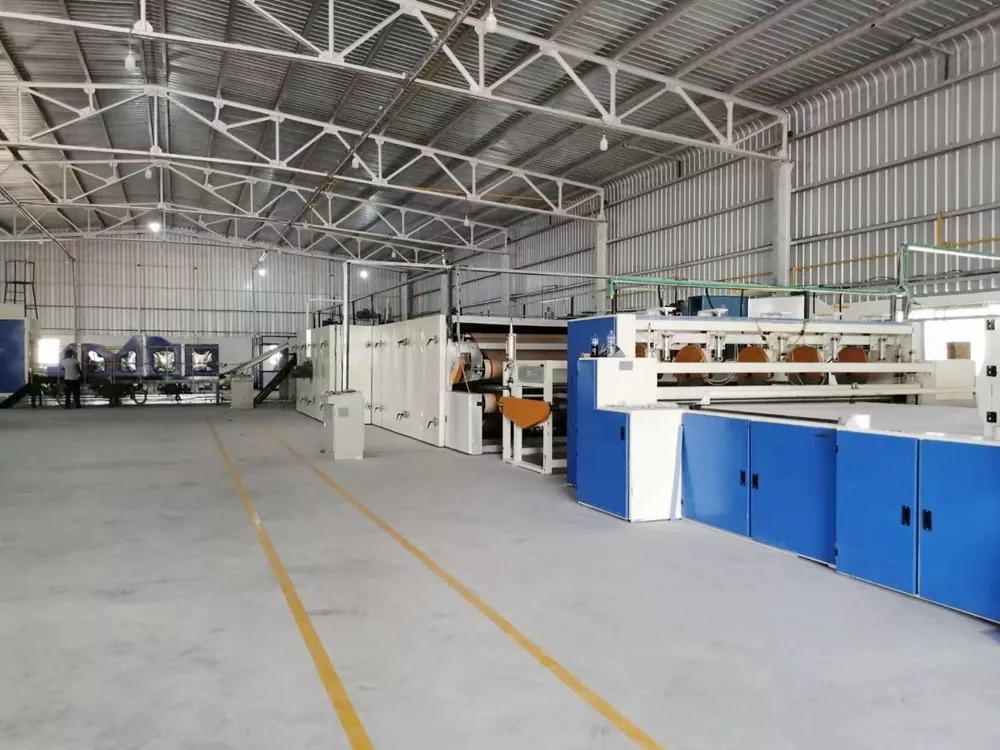
A typical needlepunched geotextile line (component view)
A standard configuration includes opening/blending, carding, web layering (cross-lapper), one or more needle looms, optional finishing, and winding. If you want a concrete example of a full-line configuration aimed at geotextiles, see Sail’s product overview for the Geotextile Needle Punching Production Line.
The 3 parameters that change the fabric most
Research and technical training materials consistently point to these as major drivers:
Punch density (how many punches per unit area)
Needle penetration depth (how deeply needles enter the web)
Needling stages / passes (pre-needling + main needling sequence)
NPTEL summarizes how needlepunched nonwoven properties depend on fiber type, web mass, needle penetration depth, and punch density in its nonwovens lecture notes. Peer-reviewed work also studies how punch density and penetration depth influence thickness, tensile, and puncture performance; for example, Rawal et al. discuss these relationships in Optimization of parameters for needlepunched nonwoven geotextiles (2008).
What to ask a line builder (so you don’t buy a “generic” configuration)
For geotextiles, ask how the supplier will help you manage:
MD/CD strength balance (carding + cross-lap strategy)
GSM uniformity across width and along roll
Needle loom configuration: number of looms, needle board approach, changeover time
Finishing choices (if any): calendering/heat setting for dimensional control
Winding and roll hardness control (important for handling and installation performance)
If you want to see configuration families beyond geotextiles, Sail’s broader Needle Punching Production Line options page is a useful starting point.
5) “Spec it so it’s measurable”: the properties and tests buyers actually use
Even if you’re a manufacturer (not a contractor), you’ll be asked for test results that align with civil specs.
Many US-facing specs reference a framework like AASHTO M288 and then use ASTM methods for index properties. Some public technical references summarize the same test-property mapping; the U.S. DOT repository note on geotextile specifications for highway applications is one such source.
Here’s a practical list of what to include on your datasheet and what each item is trying to protect you from.
What to specify | What it protects against | Typical test method family (common in specs) |
|---|---|---|
Mass per unit area (GSM) | underbuilding / inconsistent product | ASTM mass-per-area methods (commonly referenced in geotextile specs) |
Apparent Opening Size (AOS) | clogging or soil piping (wrong pore size) | ASTM D4751 is commonly cited for AOS |
Permittivity | “looks fine on paper but doesn’t drain” failures | ASTM D4491 is commonly cited for permittivity |
Grab tensile + elongation | handling/installation tears | ASTM D4632 is commonly cited |
CBR puncture | puncture during installation, stone damage | ASTM D6241 is commonly cited |
UV resistance (strength retained) | degradation during storage/installation exposure | ASTM D4355 is commonly cited |
⚠️ Warning: Don’t let the process name substitute for a performance spec. “Needle punched geotextile” is not a requirement. AOS, permittivity, puncture, and tensile values (with test methods and MARV/MARV-style reporting) are requirements.
6) Cost differences: what actually moves $/m² by process
For geotextile producers, “cost” isn’t just line price. It’s a mix of CAPEX, throughput, energy, consumables, labor, and the risk of missing spec (scrap and claims). Here’s how the four options typically differ in cost drivers:
Needle punching:
CAPEX: higher than simple bonding lines because you’re buying one or more needle looms plus web forming and cross-lap.
OPEX drivers: needles and wear parts, maintenance time, and power for the needling section.
Where it wins: when you need heavy GSM, bulk, and puncture resistance without over-engineering the polymer.
Thermal bonding:
CAPEX: can be moderate, but depends heavily on calender/oven configuration and width.
OPEX drivers: thermal energy demand and precise temperature control; performance can be sensitive to polymer blend and bonding window.
Where it wins: when you’re targeting a narrower GSM range and want stable, uniform webs at competitive speed.
Airlaid:
CAPEX: varies widely with forming method and dust control requirements.
OPEX drivers: fiber preparation/handling, filtration and housekeeping, and potential yield losses if web integrity is hard to hold at your target strength.
Where it wins: when the structure requirement leans toward bulk and uniformity, and the end-use isn’t dominated by severe installation abuse.
Spray bonding:
CAPEX: equipment itself can look “simple,” but don’t ignore ventilation, drying/curing, and emissions controls.
OPEX drivers: binder cost (often a major variable), energy for drying/curing, and QA burden to keep hydraulic properties consistent.
Where it wins: niche cases where dimensional stability or specific handling behavior matters more than maximum toughness.
Practical takeaway for RFQs: ask each supplier to quote not only line price, but also an assumptions-based operating model—target GSM range, expected speed at width, kWh per ton, key consumables, and a suggested FAT test list. That’s the only fair way to compare $/m² across different process philosophies.
6) RFQ checklist: what to clarify when GSM and width are still unknown
Because you’re not sure about width and GSM yet, your RFQ should focus on range capability and changeover reality.
Process selection questions (first pass)
What geotextile functions are you targeting (separation/filtration/drainage/protection)?
What are your heaviest expected grades (even if you don’t know the exact number yet)?
Are you designing for harsh installation (angular aggregate, heavy traffic)?
Do you need balanced MD/CD strength or MD-biased performance?
Manufacturing questions (so you can compare line proposals)
What is the supported working width range and how does speed change at wider widths?
What is the realistic GSM range for stable production (not theoretical)?
How will the line control GSM uniformity across width?
What are the planned needle loom stages and how are punch density/depth adjusted?
What is the expected energy and maintenance profile (main drivers, not marketing claims)?
What are recommended spare parts and lead times for consumables (needles, belts, etc.)?
Validation questions (FAT mindset)
Which properties will be tested at FAT (GSM, tensile/elongation, puncture, permittivity/AOS where practical)?
How will roll quality be documented (roll-level QC, certificates, traceability practices)?
If you want a visual sense of what a geotextile line looks like end-to-end, Sail’s geotextile line video can help align internal stakeholders before you go into detailed RFQ discussions.
7) Next steps (practical, not salesy)
Once you’ve defined your target application severity and your “must-hit” test properties, the fastest way to de-risk the process decision is to review:
your target property envelope (AOS, permittivity, puncture, tensile/elongation)
your expected product range (light → heavy GSM)
your width and output targets (even as a rough band)
If you’d like, you can reach out to Sail Nonwoven Machinery to discuss a configuration envelope for a geotextile-oriented line (e.g., working width range, needling stages, and QC checkpoints) without locking yourself into a single SKU too early.