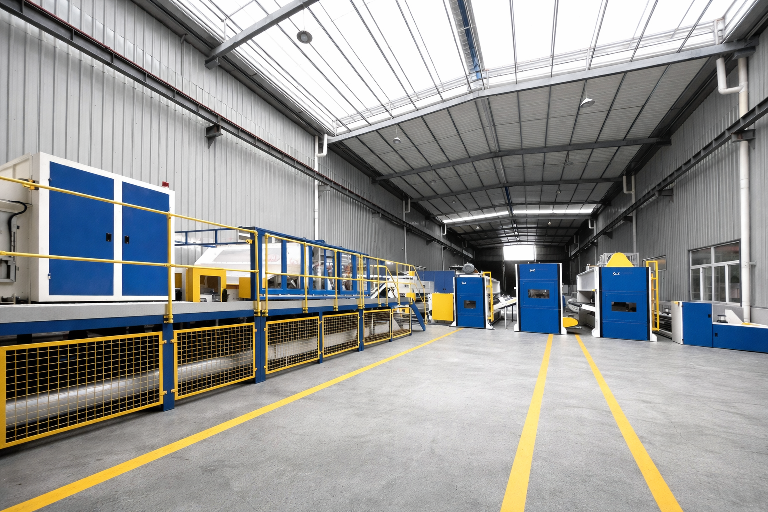
How to Choose the Right Nonwoven Production Line for Your Application
A practical guide to match your nonwoven production line to your end use — geotextiles, mattress wadding, filtration, and acoustic applications.

Ask ten suppliers to recommend a "nonwoven production line" and you may get ten different configurations. None of them is wrong, and none is right either — because you haven't asked the question that actually determines the answer.
The useful question isn't which line but which application you make and which properties that product must hit. Geotextiles, mattress wadding, filtration media, and acoustic panels all run on nonwoven lines, but they demand very different structures. A line optimized for one will fight you on the others.
This guide walks through the decision application by application, so your engineering and procurement team can discuss line choices in terms of measurable product requirements rather than machine-brand features.
Start with the end use, not the machine
A nonwoven production line is a chain of modules: fiber opening and blending, web formation (carding, air-laying, or cross-lapping), a bonding step, and finishing and winding. Most of the variation that matters for your product happens at the bonding stage — the step that decides whether the fabric comes out thick and tough, soft and lofty, dense and uniform, or open and porous.
So the selection logic runs: define the end use → define the governing properties → choose the bonding approach → size the line. When you put it that way, the mappings become fairly clear.
Application-to-line quick map
End use | What the product must deliver | Typical best-fit line approach | Why |
|---|---|---|---|
Geotextile | Thickness/bulk, puncture resistance, permeability, installation toughness | Needle punching | Mechanical entanglement builds a thick, robust, permeable structure ideal for civil works |
Mattress / wadding | Softness, loft, compressional resilience (or firm padding) | Thermal bonding (through-air for lofty; calendering for firmer) | Heat consolidates low-melt/binder fibers without crushing loft |
Filtration media | Controlled pore structure, filtration efficiency vs pressure drop | Depends on filter media requirements | Needle punching suits depth filters; bonding controls finer pores/uniform layers |
Acoustic | High loft, porosity, balanced airflow resistance, thickness | High-bulk / through-air thermal bonding (incl. V-lapper vertical orientation) | Open, porous, thick structures absorb sound |
Four notes to keep this honest:
These are defaults, not guarantees. Fiber type, denier, blend, and basis weight can shift the result within a process family.
"Needle punching line" and "thermal bonding line" are broad families; within each, configuration (number of looms, oven type, lapper geometry) changes what you can reliably produce.
Many producers run hybrid thinking — a needle-punched structure that is later thermally set, for example — so treat the map as a starting direction, not a locked answer.
The right frame is always process name plus the properties you'll test, never the process name alone.
Geotextiles: needle punching
For civil-engineering geotextiles — separation, filtration, drainage, protection, stabilization in roads, drainage, and erosion control — needle punching is the workhorse. Barbed needles mechanically entangle staple fibers into a thick, porous structure that survives angular aggregate, traffic, and installation abuse while staying permeable.
The properties you're designing for are the ones needle punching naturally serves: high basis weight and thickness, puncture and grab-tensile strength, and AOS (apparent opening size) and permittivity for hydraulic behavior. A typical geotextile needle punching line runs opening and blending → carding → cross-lapping → one or more needle looms → optional calendering/heat setting → winding. For heavy grades, multiple needling stages and a wider working width matter.
What to confirm with a line supplier for geotextiles
Supported working width and how line speed changes at wider widths.
Realistic GSM range for stable production (not theoretical maximums).
Number of needle looms and whether pre-needling is included for web stability.
How MD/CD strength balance and GSM uniformity across width are controlled.
Which properties will be validated at FAT (GSM, tensile/elongation, puncture, permeability).
Sail's geotextile needle punching production line overview is a concrete example of the module sequence used for a geotextile-focused configuration.
Mattress and wadding: thermal bonding
For soft wadding, mattress comfort layers, and padding, thermal bonding is the usual route — but the choice within thermal bonding depends on the feel you're after. Two thermal approaches produce very different structures:
Through-air thermal bonding draws hot air through the web with little compression, so it preserves loft. Because the fibers fuse without being squeezed flat, through-air products come out bulky, open, soft, and breathable — ideal for lofty wadding and cushioned mattress padding.
Thermal calendering passes the web through heated rolls under pressure, producing a denser, thinner, smoother, firmer fabric — better when you need a stable, low-profile layer rather than a pillow-like one.
Neither is "better." They serve different products. High-loft quilting fill and mattress toppers favor through-air bonding because they must hold bulk and spring back after compression. Firm mattress padding or a smooth finishing layer may prefer calendering. To bond a lofty web without crushing it, the recipe usually blends structural fibers with bi-component or low-melt binder fibers that fuse at set temperatures.
Sail offers thermal-bonding lines tuned to both ends of this spectrum, including a thermal-bonding wadding production line for soft wadding and a thermal-bonding padding production line for mattress padding.
What to confirm with a line supplier for mattress/wadding
Loft target and whether the line preserves it at your target GSM (through-air vs calendering decision).
Oven type and temperature/airflow uniformity needed for consistent bonding.
Compatibility with your fiber recipe (structural + binder fibers) and blend ratios.
Compressional resilience target and how it's measured (e.g., thickness recovery after compression).
Whether the product range spans soft wadding and firmer padding, and how changeover is handled.
Filtration media: it depends on the filter requirements
Filtration is the clearest example of why you can't pick a line from a category name alone. The right approach depends entirely on what the media must filter and at what pressure drop.
Depth and coarse filtration — industrial dust, hot-gas bag filters, and similar media — typically start from needle punching. An entangled, open, thick structure holds dirt while keeping pressure drop acceptable. The knobs that matter are fiber fineness and cut length, punch density, and needle penetration depth, with optional calendering to stabilize the surface.
Finer, more uniform, tighter-pore layers often add thermal bonding or calendering to reduce pore size and tune airflow resistance. Finer fibers and tighter needling generally raise capture efficiency, but they lower air permeability — so the choice is always a tradeoff against your efficiency and differential-pressure targets.
That's why a supplier recommendation you can act on starts with numbers: target filtration efficiency, acceptable pressure drop, particle size range, and operating conditions (temperature, chemical exposure). Only then does the needle-punch-versus-bonding choice become meaningful.
Sail's filter media felt needle punching production line illustrates a needle-punch configuration aimed at filter media felt.
What to confirm with a line supplier for filtration media
Your target filtration efficiency and acceptable pressure drop, plus operating conditions.
Whether the structure needs depth (thick, open) or fine/controlled pore behavior.
Fiber fineness/blend and how needling parameters (punch density, penetration depth) are adjustable.
Whether finishing (e.g., calendering or surface treatment) is required and included.
How consistency across the roll and roll-to-roll is controlled for reproducibility.
Acoustic: high-bulk, high-loft
For sound absorption, the physics points strongly toward open, porous, thick structures — and away from dense, compacted ones. Acoustic performance is governed largely by thickness, porosity, and balanced airflow resistance: the structure must let sound waves enter and then dissipate them internally, not reflect them off a dense skin. High-GSM needle punching can serve some acoustic mats, but the loftiest and most effective absorbers generally come from high-loft thermal (through-air) bonding, and vertical web orientation adds further openness.
That's where a V-lapper architecture becomes relevant, and it's a configuration worth comparing across suppliers instead of settling for flat cross-lapped layers. A V-lapper builds a vertically oriented, lofty batt — an especially open structure well suited to acoustic and thermal insulation, where thickness and porosity do the work. Sail's V-lapper thermal bonding production line is one example of a line built around this vertical-orientation approach.
What to confirm with a line supplier for acoustic
Thickness/loft target and target GSM, and the line's ability to hold that loft through bonding.
Pore structure and porosity you can achieve without crushing the batt.
Airflow resistivity range needed for your acoustics target and how the line controls it.
Whether a V-lapper/vertical-orientation option is available for maximum loft.
Panel dimensions and any lamination/facing steps required downstream.
Turning the decision into an RFQ
No matter the application, the same rule applies: a process name is not a spec. A proposal for a "thermal bonding line" or "needle punching line" means almost nothing until you align on measurable outcomes. When you compare suppliers, confirm you're all agreeing on the same product envelope:
Application and governing properties (loft/pore/puncture/filtration/acoustic target, with test methods).
GSM range and working width, and what output you need at the heaviest grade.
Bonding approach (through-air vs calendering; needle punch parameters) and why it fits.
Oven type or needling configuration that delivers the structure consistently.
Automation level scope and QC/roll-record expectations.
FAT scope — which properties will be proven before delivery.
Installation, commissioning, training, and spare-parts support.
⚠️ Warning: Don't be seduced by a low price on a line sized for the wrong product family. Re-configuring a line later to hit a structure it wasn't designed for is usually far costlier than buying the right configuration up front.
Choose the right nonwoven production line by starting with your product
The takeaway is simple: your end use should drive your line decision, not the other way around.
Geotextile → needle punching for a thick, tough, permeable structure.
Mattress / wadding → thermal bonding — through-air for lofty and soft, calendering for firm and thin.
Filtration → depends on media requirements: needle punching for depth filters, added bonding for fine, controlled-pore layers.
Acoustic → high-bulk, high-loft bonding (and V-lapper vertical orientation) for open, absorbent structures.
If you'd like help turning your target products into a concrete configuration envelope, the team at Sail Nonwoven Machinery can discuss which line setup suits your application, GSM range, and bonding needs before you commit to an RFQ. Starting the conversation with the right process direction is the cheapest way to de-risk a machine you'll run for years.